Tuesday, May 10, 2016

'Roids

So in spite of taking Valium to get to sleep last night, I woke up at 3 am and have been awake since then. Given the - let's say - unpleasant environment at work, you'd think I would have been up going round and round conversations I had had or worries about what was to come, but it wasn't like that at all. I felt really awake (and still do) - in fact, had the family not been at home I would have gone downstairs to do some nocturnal deejaying. Instead, I watched a film and tried a bit of meditating (which just woke me up even more) and even some yoga for goodness sake. In a way I enjoyed it and knew that I was somehow resting, even if I wasn't sleeping.

I don't know where this energy is coming from. It could be the steroids or it could be the release from annoying but fairly constant pain / discomfort. Another explanation is something I have experienced one or two times in my life when I am faced with a point of inflection in my life: a change of girlfriend, a change of country or a change of job. I don't think I will be doing any of these things but I believe that my organism goes into a kind of hyper-alert "survival mode". In the past I have had up to months of needing very little sleep, feeling very energized and alert, but also aware I am living on borrowed time. It could also be the Mindfulness that I am doing that is somehow waking me up. I've certainly noticed it bleeding over into daily situations like driving, waiting in doctor's to be attended, meetings, etc. It's too early to tell, but just two weeks in to the 8 week MBSR (Mindfulness Based Stress Reduction) course my wife got me for me birthday it really seems to be starting to have a positive effect.

The drugs are definitely helping too, and my symptoms have all but disappeared, which means that I can do my rehabilitation exercises that much more effectively and hopefully put this thing back in its box. I suspect I will have to "manage" it, just like I have to manage my Morton's Neuromas - something to be aware of, a warning to be heeded but not necessarily a stopper. My physio pointed out something interesting to me. I have two protruding discs - one between C5 & C6 and one between C6 & C7. The point is that the one between C5 & C6 is on the right hand side and yet I have no symptoms on that side of my body. It is quite possible I have been living symptom-free with these underlying problems for years without realizing it. This paints a much more optimistic picture. It may be that the "crisis" I had which lead to my back and neck locking up concentrated the pressure from the protruding disc on a small area of a nerve, leading to its inflammation and the subsequent numbness and referred pain in my left arm. This would be consistent with the order of events, because I only noticed this once the other problems had gone away and, in spite of not running, before I started medicating it just got worse and worse.

I've continued to make an effort to improve my posture and people have commented that I look taller and sit straighter. In fact I have more or less stopped using my Lumo Lift as I feel that awareness of my posture (and the typical causes for breaking it) has been internalized now (here Mindfulness helps with the awareness too). So I'll probably lend it to my wife for a bit, as she could do with minding her posture a bit more. My Shoulders Back brace did arrive after all (albeit with an unexpected customs bill of about 30 €...) and I really notice that it helps me stand up straighter and taller. It's comfortable to wear during the day under a shirt (and I have found a way of taking it off and putting it on discreetly when I get changed in the gym) but I think that I would have to wear it on the outside of a t-shirt if I were to run with it, because otherwise it would cause too much chaffing. I expect that it will help strengthen some of the muscles that are indirectly implicated in a more upright posture - such as the internal neck muscles I have been exercising recently - but others, like those that help stabilize my scapulas, are probably having too much of an easy time of it and need to be strengthened separately. I'll see what my physio has to say on the matter. Lastly, I bought yet another gadget to help me on the road to recovery: a goose-neck support for my Kindle, so that I can watch movies and series while on the elliptic, without having to crane my neck. I hope that all these measures (plus the new chair I mentioned last time) will help me be in better shape for when I come off the meds and - hopefully - gradually re-introduce myself to running and cycling.

Thursday, May 5, 2016

Whoopsie

I got the results back of the MRI - which, by the way was a form of torture as my nerve was compressed during the entire 20 minutes which seemed like an eternity. So it turns out that I do have a slipped disc. Actually, it is not a herniated disc but rather a protruding disc (slightly between C5 & C6 and more "voluminously" between C6 & C7) which is pressing against my nerves. So I have been prescribed a course of corticoid injections for which I have to present my bum to a nurse every morning for the next couple of weeks. I'm also on anti-inflammatories (Enantyum) and have a follow up appointment with the spinal column specialist at the end of the month. I hope that the combination of the meds and the rehab prod the disc back into its little space and that I can avoid surgery.

It's been a difficult time one way and another. At work there is a dour mood as about 25% of the workforce will be cut in the next couple of weeks: we are just waiting for the axe to drop. If its not you, it might be a friend or someone you count on to be able to do your work. Also, my mum has been in hospital for over two weeks, recovering from (her second) bone fusion in her lower back to conserve the discal space lost to degenerative disc disease* and to relieve pressure on the sciatic nerve. It's funny that I should have a similar (less serious) problem at the same time as her. When she had her bunions operated I was having problems with mine; she had problems with Morton's Neuroma at the same time as I did. I wonder if I am suffering from some form of maternal stigmata.

Still, when patience is called for, I can be patient, and this is one of those times. My wife gave me a course on Mindfulness for my birthday which requires a fairly serious commitment (I am meditating for almost an hour every morning). I have to say I don't feel like taking anything else on right now, but I think it is helping. It's time to look after mind and body.

I got a new chair at work, which is much better for my back than the previous piece of crap. I had to go through some bureaucracy to get assigned one and, by a strange coincidence, the whole floor got given a new ergonomic chair (worth about 700 euros) the day before. This at a time when we are wondering whether we will be moved to another office or shipped out of here altogether. Unfortunately I found this chair (a Steelcase "Think") to be worse than the chair I had before, as it is impossible to block in an upright position, so you end up leaning backwards. Looking around the room, not a single person is sitting with good posture: some are leaning back with their necks craning forward, while others are slumped down in the chair as if they were watching the TV. I had to make an extra special fuss to get assigned one of the other orthopedic chairs - a Karnapps - which I think is much better.


I mentioned in my previous post that I had ordered a "Shoulders Back" brace to try to help with my posture. It hasn't arrived yet due to a peculiar limitation in Spain whereby individuals are not allowed to take delivery any item that is classified as "for medical use" - even if it is just a piece of cloth - instead, you have to order through a pharmacy. As I understand it, the pharmacies in Spain operate under a slightly communist regime in that you can only open a pharmacy where there was one before or, in rare cases, if the local government decides there is enough demand to open a new one. So, in practice, they get handed down through families and are a bit of a monopoly. Once I get my money back for the two failed attempts so far, I'll have it delivered to the UK instead.

You may remember that I bought a little device - the Lumo Lift - some time ago, before the problems with the pinched nerve were noticeable. This gadget buzzes every time you slump in your chair or while standing. I've just realized that the pinched nerve has exactly the same function, although it is a good deal more effective: whenever I lean forward or assume a bad posture, my thumb and first two fingers on my left hand go to sleep and I get referred pain in the triceps and the lats. It is doing wonders for my posture, I can thoroughly recommend it. The only difference is that I can decide not to wear the Lumo Lift but I can't turn off the pinched nerve just yet.

Having said that, the steriods (corticoids) I am taking are already having a noticeable effect. On the plus side, the symptoms from the pinched nerve have retreated to where they were 2-3 weeks ago after just one injection. On the minus side, I was totally hyper last night (and in fact, still am this morning) and only slept 3 hours. The best (or worst) thing about it is that I don't even feel tired. I feel almost euphoric, like running a marathon which, of course wouldn't be a good idea right now.

* I discovered in that place of all true knowledge more commonly known as the internet, that "degenerative disc disease" is neither degenerative - in the sense that there is no reason why the discs will necessary degenerate further - nor is it a disease. It just means that your discs have degenerated, but you already knew that.

Tuesday, April 19, 2016

Update

So, this thing is still dragging on. I am much better in many ways, but I have a pinched nerve which is causing pain and numbness to radiate down my arm to my fingers. Occasionally - perhaps after sitting still for a long period of time - it can feel like someone punching me in the arm, painful enough to make me stop in my tracks, but then it subsides after a few seconds. It's rather like the nerve pain I started to get in my feet almost exactly 2 year's ago, due to the Morton's Neuroma, in the sense that the pain is probably worse than the damage itself. The difference in this case is that there is a chance that the nerve could become permanently damaged and you can't just have it removed (unlike the nerves between your toes) without serious consequences. I've been to see a "traumatologist" who wants to rule out the possibility that the nerve is being compressed by a slipped disc in my neck: this would be one of the worst outcomes and could require surgery. (She told me that she wasn't scared of surgery; I said I was.) So I am getting an MR scan this Friday.

In the meantime, I am seeing the physio once a week and she is prescribing me exercises to mobilize and strengthen certain areas. It's slow progress but it is progress. One of the exercises, for example, is something known as "nerve flossing" where you basically slide the nerve back and forth through its sheath. This has to be done in a range that doesn't cause pain (and therefore inflammation).


She also gave me a book about pain which I will probably read some time over the next two days, as I am going down to Málaga where my mum is having a fairly serious back operation. But the book is for me, not for her. It's interesting how pain works - the pain I am suffering from is not that extreme but it restricts me, and I associate it with certain movements and activities. Above all, it is frustrating. I haven't read the book yet, but I can imagine that the intensity of pain is not the only important aspect, but what it is associated with, how constant it is and what our attitude towards it is. I remember how I got a bit obsessed with the pain in my feet from the neuromas; now I can't remember the last time I felt it.

In terms of "proper" exercise, I am only really able to use the elliptic machine, without moving my arms. It's better than nothing, but it does make me dependent on the gym which I can only use during the working week. Right now, things are pretty difficult at work as there are severe cuts and many people will be made redundant. This is exactly the time when having an outlet like running is so valuable. Instead, I am finding myself going back to an old remedy: listening to music or, more precisely, my previous hobby of deejaying. In other news, my treadmill finally got fixed yesterday after almost 6 months. In the end, the rollers and the belt had to be replaced (on top of the already new board and springs). As the guarantee is up in a month's time, its probably just as well to have it renewed and, if my running continues at a lower intensity from now on, there's a chance it might last me a few more years yet. The custom made plywood running deck is much better than the one that came as standard, and is much less springy.

I've been using my Lumo Lift device every day at work and my sitting posture has improved noticeably. I'm wearing glasses which I can get away with not using, but they help me avoid craning my neck forward to read the small writing on my screens. I've also managed to get approval for a special chair at work which is more supportive, especially for the neck. My first focus is on correcting my "tech-neck" and then I will turn my attention to my Anterior Pelvic Tilt. Following a recommendation from my osteopath, I've bought a brace that helps hold my shoulders back, encouraging a more upright posture that will ultimately strengthen muscles in my neck and upper back. I noticed that there was a huge variety in designs so I initially had trouble choosing between them, until I had the idea of Googling for "shoulder brace running". I discovered that Alberto Salazar has his star runner - Galen Rupp - run with a shoulder brace that was actually designed for jockeys - the Equifit Shoulders Back. I'll let you know how I get on with that when it arrives.

Tuesday, April 5, 2016

Redefining "best"

Nowadays many schools have "non-competitive sports days" which I think a bit "oxy-moronic". My wife and I don't quite see eye-to-eye on this one but, while she will tend to say to the kids "The important thing is the taking part, not the winning" I usually add that "As long as you feel you've done your best, that's all that matters". But always doing your best is quite a tall order. It never ceases to amaze me how the best athletes in the world are not only able to put out stratospheric performances, but they seem to be able to do it time and time again with extraordinary consistency (notable exceptions like Paula Radcliffe aside). I expect that this is no coincidence and that consistency - especially in training - is key to being at the top of your game.

I have never been particularly consistent. I have run 10 Marathons, approximately half of which I have been very happy with and half I have been disappointed with. My most recent Marathon - in New York last November - was one which fell into the "disappointing: could do better" camp. At the time friends and family couldn't understand my disappointment, and some even tried to convince me to be satisfied with my result but - after a few weeks of grouchiness I must admit - I chalked it down to experience and started to think of the next one. The odd sub-par performance is an inevitable result of my strategy to get as close to my optimum level as possible.

As long as it was just a question of the odd disappointment, it was no big deal; in fact, it made victory all the sweeter when it finally showed up. But I have started to suffer other negative effects that are perhaps not too surprising given that I am getting on a little bit (about to turn 44). I just need to search through my blog for "back", "neck" or "shoulder" to see just how often. I have continued to soldier on - most times without having to skip even one training session - but the stakes have started to get too high and interfere with other spheres of my life.

How can I redefine "best" so that I can still feel satisfied with my performance? I don't feel enough motivation to train just to fun-run a Marathon. One approach would be to just run for the pure enjoyment of being outside, the endorphins, and feeling good about my body - and forget about races altogether. I'm not sure that that is motivation enough for me just yet - although, right now, I'd do anything to be able to go outside for a run, however slow.

Being a mathematician, I think of my theoretical best performance as being a red line, rather like the red line on the rev-counter of a car. If you can train and race as close to that line without ever crossing it, then you should get your best possible result. Up until to now, crossing the red line has has fairly manageable negative consequences, but that seems to be changing. So, if consistency is represented by a bell-curve - the wider the bell-curve, the higher the inconsistency - to avoid crossing this red line means shifting the intensity of all your training downwards.

This is somewhere between my previous extreme of always trying my best and the other extreme of just running for fun. I tend to be a bit of an all-or-nothing guy, so I feel uncomfortable in that grey zone in the middle. I'd always ride my bike in the lowest gear to get started and then immediately shift up to the highest possible gear - what was the point of all those gears in the middle? I always used to listen to my Walkman at the highest possible volume and found the volume control to be a nuisance. Where do I set the intensity dial for my training?

I think the trick is to shift the time horizon out beyond the current training session, the current week and even beyond the race I might be training for. If consistent, problem free running is a must, then "doing my best" means "doing my best while minimizing the chance of crossing the red line". I'm not sure yet how this translates into a training program, but I can try doing all my training at an "easy" pace (not slack, mind you), scaling back the long runs and mixing in some cross training and weights, and I can try running races at a pace that feels lively but not demanding. If I cross the red line - which I suppose will happen now and again, especially as I get older - I just have to be prepared to shift everything downwards. I've got into Chicago with a qualifying time so it seems a shame not to take advantage as training for and running Marathons like this is unlikely to lead to qualifying times in the future (and, in any case, I have paid my $210 already).

More than anything else, I need a challenge that I feel that is just within my reach and is within my control. Work is a challenge but it depends on so many other factors and people; running has been a great complement (and indeed compliment) to my self-esteem in this respect. Running my best in the long run will probably be the hardest running challenge I have ever undertaken.

Probably the closest I ever got to that red line (since I took up running again) was when I ran New York City Marathon in 2:47:42 in 2013. I am extremely proud of that achievement because it was the culmination of years of training, of overcoming injury and low self esteem, not to mention the 5 years it took me to be get into the race in the first place. Many times I have thought of getting a discreet tattoo - somewhere where it doesn't look like boasting, but somewhere where I can be reminded of it - but it has felt too much like giving up and admitting that I will never run that fast again. Now I am thinking again of that tattoo but not as a resignation, instead as the closing of one chapter and the start of another.

Wednesday, March 30, 2016

I spoke too soon...

I don't know whether it was the easy 20 minute run I did last night, the effort of keeping a good posture or just simply sitting down for so long, or maybe having slept in an awkward position - but my neck has seized up again. This pisses me off a lot more than just my shoulder hurting as it makes it difficult to go about everyday life and certainly puts running on hold again. Got an appointment with the physio in just over an hour and, tomorrow, I'm seeing the osteopath.

Tuesday, March 29, 2016

Sermana no tan Santa

It wasn't the best Easter break ever, I have to say, with my back problems and a bout of gastroenteritis (first the eldest, then the youngest, then me), but it was nice to be able to visit my brother and his family in London, my sister-in-law in then my parents in Málaga and, finally, my parents-in-law in Ciudad Real. My brother-in-law, Vicente - a trained osteopath - was able to give me an excellent massage which went a long way to making me feel better, but it wasn't until yesterday that I was able to run again, for the first time in three weeks. That's the longest break I have had from running in about 7 years (and certainly since I started this blog). In that time, my VO2 Max has dropped to 63, my % fat risen to 8.5% and my average resting heart rate gone up to 44, which is about where I was when I started my training back in January. So three weeks of de-training = seven weeks of training. Sounds about right.

I'm still not 100%, but of my three recurring complaints which seemed to collide in a general back seizure - stiff neck (from bad posture at work), sore shoulder (from prior injury) and lower back fatigue (from running with weak hips) - I am just left with slight shoulder pain. I'm going to start seeing a physio regularly to work out what I can do to help prevent these problems. In the meantime, what better therapy than that of the retail kind?

So, I bought myself another gadget, the Lumo Lift, which is a little device that "bugs" you if you slouch while sitting or standing. It's a very simple little thing with a tilt sensor that you calibrate once when you are sitting with what you deem to be good posture and it alerts you by vibrating if you break this posture for more than a configurable amount of time. There is an accompanying app which is not actually necessary, but helps by tracking how many hours you have managed to keep a good posture each day, as well as the number of steps you have taken. It's not really aimed so much at the fitness crowd as it wouldn't work as an activity tracker while running (it is affixed with a small magnet to your clothes) but instead at people with a sedentary job, like myself.

For once it is a product that works slightly better for women than men, as they can attach it more discreetly to their bra strap; men have to place a small magnet on the outside of their shirt, just below the collar bone. You get two of these magnets in the box - silver and black - but you can buy extra colours if you care that much about discretion; I don't. So far it is too much of a novelty for me to have forgotten about sitting with good posture long enough for it to have buzzed me. Although, at first, sitting with good posture is bound to be more tiring (in the short term) than slouching, I'm finding I am able to sit for quite a while without problems and, the good thing is, that you end up finding more comfortable ways to sit while still sitting with good posture, as well as becoming aware of those situations (like answering the phone) that lead you to break that posture. It may be coincidence, but I have noticed that I am a bit more sweaty than usual - perhaps I am making more of an effort by sitting up straight, akin to standing up. I think the trick is neither to slouch nor to sit bolt upright, but getting the right balance is a bit tricky at first. When I get tired, instead of slumping in my seat as I would normally do, I now get up and go for a little walkabout.

The Android app is supposedly still in beta and is not even officially compatible with my phone (Samsung Grand 2) but here I think they are just being conservative. I have installed it anyway and it works fine (so far). The same company also makes a product called "Lumo Run", which is basically a pair of fancy pants which tell you if your pelvis is correctly aligned while running. It sounds like these would be just the thing to address one of my other regular complaints - that of my lower back problems due to my lumbar region overcompensating for my lack of strength in the hip flexors. i can't really see myself buying these as I am quite particular about running shorts, but I can imagine them being a great tool for running coaches (with a good washing machine). (I've noticed that they are now offering just the sensor, which you can attach to any pair of running shorts. I'm a little skeptical of how well this works because, it's clearly preferable to the integrated version so, unless it is much less accurate, why offer both products?)

In other news, I got accepted to run the Chicago Marathon!! The other good news is that I managed to convince my wife that the family holidays would be somewhere cool again this year, so we are going to Norway and Sweden, where training during the summer should be relatively easy, provided I get up early.

Wednesday, March 9, 2016

Madrid Marathon Week 11/18

I was going to write a very positive report for this week because the training went very well and I hit all my pace targets (and some). Maybe it is not such a coincidence, then, that my back is worse than I think it has ever been, to the point that a colleague had to drive me home in my car yesterday, while another one came along to take the first one back to the office. But more of that in a moment.

The week started off with a surprisingly spritely run around the the football pitch. This was supposed to be an easy run - at a pace of between 4:26 and 4:46 / km - but (GPS error permitting) turned out to be 10km at a pace of 4:05, a smidgen above my supposed marathon pace. One of the things I like about my Garmin Fenix 2, is the VO2 Max metric, which probably has little to do with my real VO2 Max, but does seem to track my fitness very well. It makes even the easiest and most boring runs interesting by giving me a goal: after this one, my VO2 Max soared to 66 ml/s/kg.


...that of a 2:30 Marathoner! (I wish)


Tuesday marked a shift in the Hanson's plan from "speed" to "strength" and a move towards more, longer and slower intervals. The recommended pace for these was about 10 seconds faster than Marathon Pace - which I had set at 3:55 /km as running on the track is somewhat easier than on the roads with their ups and downs. Instead of running the 6 sets of 1 mile at 3:45 /km, I ended up running them (very consistently as it turned out) at 3:35 /km. This was partly because I was used to running the speed intervals at 3:25 /km and partly because my watch was displaying my instantaneous pace, rather than the average pace I was clocking up.

Thursday was another "Something Of Substance" (SOS) workout, being a 13 km (8 mile) run at Marathon Pace, again executed slightly faster than required at a pace of 3:52 /km. A few more easy runs and then all that was left was the long run on Sunday. But I'm getting ahead of myself...

I woke up on Saturday with a stiff neck and shoulder, but nothing too worrying. I bought some bath salts and treated myself to a very long hot bath while watching House of Cards Season 4. I didn't much fancy going for a run, especially as it was one of those cold, grey, non-descript kind of afternoons but, after a few reluctant kilometres, the pace seemed to pick itself up naturally as my back loosened up.

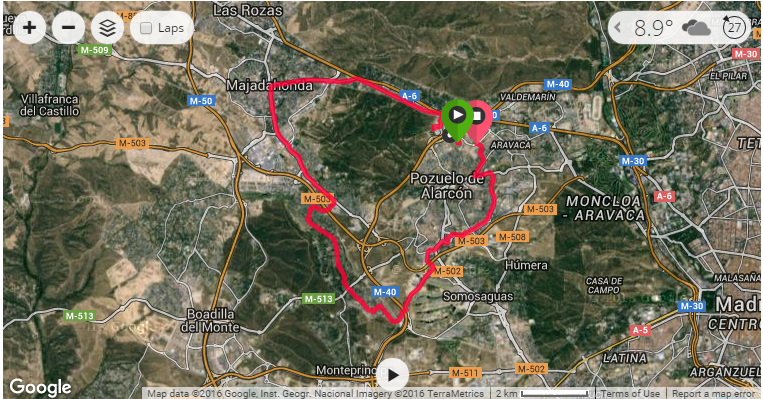
On Sunday my back was even stiffer and I started to get nervous about the impending long run. I also had some chores to do - namely, varnishing hundreds of slats of wood that would soon turn into a new garden shed. Again, my back felt better rather than worse as it warmed up, and the run became less of a worry. I'd designed a new route


which turned out to be very good: all on roads, not too many hills and with most of the ascent out of the way by half way. If my long run pace was supposed to be 4:17 /km, I surprised myself by putting in a 4:06 /km effort. All in all, a good week with 93 kilometres in the bag.

On Monday my back (or, more specifically, my left shoulder and neck) was really uncomfortable. I rang all the physios in the area and ended up going to an osteopath at lunch time. There is little more satisfying than the series of  "clicks" he managed to solicit, and I went back to the office a new man. He made a comment about how strained my muscles around the scapula were but - if he thought that complete rest was a good idea, he probably thought I was old enough to realize this for myself. There is a reason why the muscles "lock up" and that is to protect a damaged area so, if you unlock this area prematurely, you can lay yourself open for further injury - at least, this is my home-cooked theory. So I went for an easy run around the track after work. About 8 kilometres in, someone appeared on the track - unusual for that time in the evening where I work - and, although they looked like they were running easily, they seemed to be catching me up. Just at that moment, a drum 'n' bass track came on my iPod and the combination of the high bpm and high testosterone made me pick up my pace. Even so, I got lapped by this new comer... It was then that I realized that he wasn't just anyone - he turned out to be the trainer who works at the gym who runs 800m in 1:49 (the World Record is 1:40.91!!). More fool me.

I paid for my accumulated stupidity on Tuesday. Although I was able to drive in to work, by 11am my back had locked up so much that I had to get a colleague to drive me home. I then went to Emergencies to see if I could get a shot of something to ease my muscles. The doctor saw me clutching my left arm and prodded a few places (but the wrong ones) in my back and was surprised that poking me didn't seem to provoke pain. So, of course, he thought I might be having a heart attack. (I don't say this with any sarcasm - of course there are procedures that have to be followed, and for good reason.) They did a cardiogram on me and when they asked me if I did a lot of sport, I mentioned to them the fact that I had a CRBBB (Complete Right Bundle Branch Block that Peter Piper Picked...). Nevertheless, I had to spend the next 6 hours waiting for various tests to be completed and analyzed. Finally, I was told by a beaming doctor that it was "Good news! The tests have come up OK, you are fine! You can go home now!". I tried to look relieved although I'd already had all that checked out (and in the very same hospital) some time ago, and said, as patiently as a patient can be, "Great, but the fact is that I came here because my back was hurting and you haven't given me anything for it...". "Ah! I'll hook you up now!". So I got my dose of Valium at last, and headed home (with my wife driving, of course). I was also prescribed a cocktail of hard drugs: Enantyum, Nolotil and Diazepan. By coincidence, while I was waiting the entry for the Chicago Marathon opened.

There are some very good reasons why my back is my limiting factor. To start with, I spend most of my day sitting at a computer with a less-than-ideal posture. When I am in training for a Marathon, I tend to lose weight and some of that is bound to be muscle - I guess my body chooses to shed what it thinks it will need less, and that is from my torso. Also, I think I lack hip-strength and tend to compensate with my back, usually leading to very sore spots just under my ribs on each side. But the real reason - and the real cause of my pain this time - is an accident I had over 5 years ago, when I went flying off my mountain mike in an Evel Knievel stylee and tore all the ligaments in my shoulder (ACL grade III). Apart from lending asymmetry to my whole body, this means that my left scapula is less supported than it should be, and the little muscles around it tend to get overworked. Every so often they go on strike - and who can blame them? The answer - because surgery doesn't seem to be a very good option - is to strengthen them.

So. Now what? I've taken a decision to either NOT run the Madrid Marathon, or to run it tranquilamente. Either way, there will be no "Madrid Marathon Week 12/18". I've also signed up for the Chicago Marathon, which I should get into with my New York Marathon time from last year. This was supposed to be a rehearsal for the Chicago Marathon - in particular, following a new training plan. I've definitely learned some things:

- I like the Hanson's plan - even if it looks easier on paper than the one I was following leading up to New York, it is actually quite demanding.
- It's important to run the easy runs easy, or to at least listen to your body and allow some of them to be really easy.
- It takes many weeks to get back in shape, even if it wasn't that long ago that I was last in shape. In other words, one "detrains" faster than one trains. It's important not to get discouraged during these early weeks and it is probably a good idea to start the training plan from week 1.
- My back is my limiting factor. Between now and starting up my training for Chicago I am going to strengthen my back and build into my daily routine a set of exercises to maintain strength that I will stick to come hell or high-water. Back pain is not fun.
- Running outside is quite different from running on the treadmill and I am perfectly capable of adapting to the relative "boredom" (compared to watching my favourite series while I run). Even running 13 kilometres round and round a track hasn't been so hard to get used to.
- I have to pay heed to my back pain and not just "run through it".

Monday: 13 km @ 4:05 (track)
Tuesday: 6 x 1 mile w/ 400m recovery @ 3:35, 3:35, 3:33, 3:37, 3:34, 3:35
Wednesday: -
Thursday: 13 km @ 3:52
Friday: 11.3 km @ 4:18
Saturday: 9.8 km @ 4:28
Sunday: 25.8 km @ 4:06
Total kilometres: 93

VO2 Max (Garmin): 64 ml/kg/min
Resting pulse (average): 40 ppm
Fat (average): 6.7%