
Yet another blog chronicling the mid life crisis of some bloke. Only it is for a good cause and you might even learn something from my obsessive travails... Even if it is just what NOT to do.
Wednesday, October 14, 2015


New York City Marathon 2015 Week 8/11
This was the big week in terms of kilometres (over 100) but my so-called "peak week" actually starts now, as I write this, and is more intense.
My upper back and neck have continued to be painful the whole week. I now know why they invented the swivel chair for sedentary office workers. I made an appointment with my osteopath but I have to wait until next week. Having said that, in a meeting this morning, I got an incredibly satisfying series of "cracks" out of my neck (that must have been quite audible) and feel a lot better for it. Nevertheless, I think it will be a good idea to unlock some of the tightness that has been accumulating there.
Generally I have been re-reading my blog for the equivalent training week from 2 years ago but it was just as well that I didn't remember to do so before my workout on Monday which, back then I claimed was one of the hardest. It was still pretty tough - 45 minutes increasing the pace every 15 minutes from 4:00 /km (15 kph) to 3:40 /km (16.5 kph). More than anything it is psychologically challenging to know that you have to not only keep going, but be prepared to run even faster.
On Wednesday I went out for my usual hour long run and it turned out to be the day of the flying ants. At first I mistook them for floating bits of ash from a bonfire, but soon realized what they were. Luckily I was wearing my sun glasses so I only had to watch out for them flying into my mouth. One thing I did while preparing for NY two years ago was to do a number of "hill sprints": i.e., charging up a slope of around 10% as fast as possible. The idea then was that this was to be a form of strength training. This year, as I have gone for so long without doing weights and because I feel that I have lost a bit of muscle mass, I have been going back to the gym. This week I decided to switch over to the hill sprints - the last thing I felt like doing after running for an hour, I can tell you. What I hate about them is that there is no immediate relief when you get to the crest of the hill. In fact, it is almost the opposite: as you run up you feel fine most of the way but, when you stop, your heart and lungs feel like they are going to explode.
This lag is quite disconcerting because it feels like there is nothing you can do to make it go away (except wait). It reminds me of when I drink the smoothies (made from ultra frozen fruit) at the gym too quickly and get a brain freeze that seems to last for ever. Just yesterday I was listening to a talk by Sam Harris in which he was arguing that how you frame pain can completely change it. For example, when you are lifting weights you might feel discomfort and muscle burn. This might be something that you would actively seek to feel, as a confirmation of the hard work you were putting in. But if you were to wake up with the very same pain for no apparent reason, it could prove to be intolerable.
At the weekend we set off for Asturias as Monday was a bank holiday. But so, it seemed, did half of Madrid. To give you some idea, in a bar we stopped at for a sandwich along the way, I bumped into two separate people I knew, also on their way to Asturias. The traffic was so bad that we decided to try to break our journey. Thanks to the advent of smartphones and a bit of luck, we were able to find a hotel with a room for the four of us and the dog at a reasonable price and very close to the motorway. The only downside was that it wasn't a very good location to go for an early run. The run I had programmed for Saturday was the typical run I would do on the treadmill as it consisted of 70 minutes continuous running, alternating between 2 minutes at 3:45 and 3 minutes at 4:27. I worked out that this corresponded roughly to 600 m at 3:45 followed by 600 m at 4:27 and found a simple loop of this length to run around in Villaviciosa. If anything this was slightly harder than the original workout as the hard loops were slightly longer and the recovery loops slightly shorter. Also, running 29 times around a park is not my idea of fun. I managed to hit all the paces on the hard loops and most of the paces on the recovery loops but, as I got towards the end, the recovery was not enough of a recovery and I started to slow down a little. Talking of recovery, my Garmin Fenix 2 watch advised me to take 67 hours to recover from my efforts.
Of course, that I didn't do. Instead I ran 35 kilometres. Asturias is particularly hilly but, with a bit of insider knowledge and ingenuity, I was able to design this flatish route with only about 350 metres of climbing. In fact, I started from Villaviciosa and ran the right hand branch first, as this was the more hilly of the two, before attacking the left hand branch. The curious thing about the route is that it very nearly joins up at the top but is separated by a stretch of about 100 m of water (depending on the tide). For a shorter (17 km) version, I could try swimming across the "ria".
To get down to the start, I took the quad bike - a capricho from my midlife crisis a few years ago. It is a lot of fun to ride but it uses up a fair amount of mental and physical energy to navigate the windy roads. I got my replacement waterproof iPod Shuffle in the post just in time to use it on the run (the previous one had a very short battery life for some reason). The guys at Underwater Audio have to be praised for their quibble free service and for putting the customer first, as they sent out the replacement via Amazon as soon as they had received the tracking number of the one I returned.
The run itself started off well and felt nice and easy, as is usually the case. The hills didn't present much of a problem and I enjoyed the scenery. It was psychologically hard to have to run past the quad after 20 kilometres, to complete the final 15 kilometres. At the turn around point, with 7 kilometres or so to go, I started to feel weak, tired and even a little sick. I had hit the wall. Not such a bad thing as I think it is important to suffer this in training every now and again (and better than in the Marathon itself, where motivation, proper rest and, above all, energy gels will help avoid this). On the other hand, it can have a demoralizing effect, which I tried to minimize. I stopped 3 times on the way back and lay down by the side of the road, hoping no-one would stop to ask if I was alright.
Eventually, of course, I made it back (otherwise I wouldn't be writing this blog, for one thing) and - after downing a couple of cans of Coke Zero - headed off on the quad to meet my family at the Espasa beach near Colunga, where I ate and drank myself back to normal.
Monday: core
Tuesday: 45' (15' @ 4:00, 15' @ 3:45, 15' @ 3:40)
Wednesday: 60' @ 4:15 + 5x hill sprints
Thursday: 40' @ 4:00
Friday: 60' @ 4:08
Saturday: 70' (600 m @ 3:45, 600 m @ 4:27)
Sunday: 35 km @ 4:23
Total kilometres: 103
My upper back and neck have continued to be painful the whole week. I now know why they invented the swivel chair for sedentary office workers. I made an appointment with my osteopath but I have to wait until next week. Having said that, in a meeting this morning, I got an incredibly satisfying series of "cracks" out of my neck (that must have been quite audible) and feel a lot better for it. Nevertheless, I think it will be a good idea to unlock some of the tightness that has been accumulating there.
Generally I have been re-reading my blog for the equivalent training week from 2 years ago but it was just as well that I didn't remember to do so before my workout on Monday which, back then I claimed was one of the hardest. It was still pretty tough - 45 minutes increasing the pace every 15 minutes from 4:00 /km (15 kph) to 3:40 /km (16.5 kph). More than anything it is psychologically challenging to know that you have to not only keep going, but be prepared to run even faster.
On Wednesday I went out for my usual hour long run and it turned out to be the day of the flying ants. At first I mistook them for floating bits of ash from a bonfire, but soon realized what they were. Luckily I was wearing my sun glasses so I only had to watch out for them flying into my mouth. One thing I did while preparing for NY two years ago was to do a number of "hill sprints": i.e., charging up a slope of around 10% as fast as possible. The idea then was that this was to be a form of strength training. This year, as I have gone for so long without doing weights and because I feel that I have lost a bit of muscle mass, I have been going back to the gym. This week I decided to switch over to the hill sprints - the last thing I felt like doing after running for an hour, I can tell you. What I hate about them is that there is no immediate relief when you get to the crest of the hill. In fact, it is almost the opposite: as you run up you feel fine most of the way but, when you stop, your heart and lungs feel like they are going to explode.
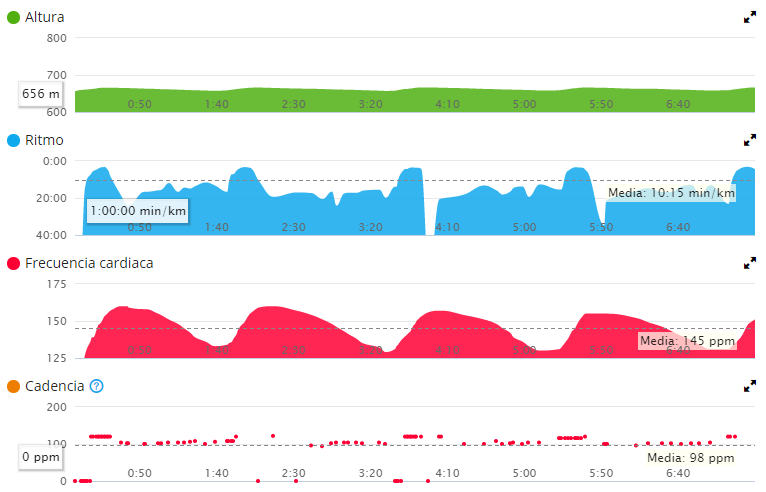 |
| Here you can clearly see the lag between ascent (altura), pace (ritmo) and HR (frecuencia cardiaca) |
At the weekend we set off for Asturias as Monday was a bank holiday. But so, it seemed, did half of Madrid. To give you some idea, in a bar we stopped at for a sandwich along the way, I bumped into two separate people I knew, also on their way to Asturias. The traffic was so bad that we decided to try to break our journey. Thanks to the advent of smartphones and a bit of luck, we were able to find a hotel with a room for the four of us and the dog at a reasonable price and very close to the motorway. The only downside was that it wasn't a very good location to go for an early run. The run I had programmed for Saturday was the typical run I would do on the treadmill as it consisted of 70 minutes continuous running, alternating between 2 minutes at 3:45 and 3 minutes at 4:27. I worked out that this corresponded roughly to 600 m at 3:45 followed by 600 m at 4:27 and found a simple loop of this length to run around in Villaviciosa. If anything this was slightly harder than the original workout as the hard loops were slightly longer and the recovery loops slightly shorter. Also, running 29 times around a park is not my idea of fun. I managed to hit all the paces on the hard loops and most of the paces on the recovery loops but, as I got towards the end, the recovery was not enough of a recovery and I started to slow down a little. Talking of recovery, my Garmin Fenix 2 watch advised me to take 67 hours to recover from my efforts.
Of course, that I didn't do. Instead I ran 35 kilometres. Asturias is particularly hilly but, with a bit of insider knowledge and ingenuity, I was able to design this flatish route with only about 350 metres of climbing. In fact, I started from Villaviciosa and ran the right hand branch first, as this was the more hilly of the two, before attacking the left hand branch. The curious thing about the route is that it very nearly joins up at the top but is separated by a stretch of about 100 m of water (depending on the tide). For a shorter (17 km) version, I could try swimming across the "ria".
 |
| There and back the long way round |
The run itself started off well and felt nice and easy, as is usually the case. The hills didn't present much of a problem and I enjoyed the scenery. It was psychologically hard to have to run past the quad after 20 kilometres, to complete the final 15 kilometres. At the turn around point, with 7 kilometres or so to go, I started to feel weak, tired and even a little sick. I had hit the wall. Not such a bad thing as I think it is important to suffer this in training every now and again (and better than in the Marathon itself, where motivation, proper rest and, above all, energy gels will help avoid this). On the other hand, it can have a demoralizing effect, which I tried to minimize. I stopped 3 times on the way back and lay down by the side of the road, hoping no-one would stop to ask if I was alright.
Eventually, of course, I made it back (otherwise I wouldn't be writing this blog, for one thing) and - after downing a couple of cans of Coke Zero - headed off on the quad to meet my family at the Espasa beach near Colunga, where I ate and drank myself back to normal.
 |
| "Wow, that guy looks knackered" |
Tuesday: 45' (15' @ 4:00, 15' @ 3:45, 15' @ 3:40)
Wednesday: 60' @ 4:15 + 5x hill sprints
Thursday: 40' @ 4:00
Friday: 60' @ 4:08
Saturday: 70' (600 m @ 3:45, 600 m @ 4:27)
Sunday: 35 km @ 4:23
Total kilometres: 103
Monday, October 5, 2015
New York City Marathon 2015 Week 7/11
The main event this week was the XIX Mariano Rivas Rojano Memorial Half Marathon in Alcázar de San Juan. Someone asked me what time I was aiming for and I said that if I did 1:19 I'd be really happy but if I did 1:21 I'd be pissed off - this just shows how much pressure I was putting on myself.
The weekend didn't get off to a very good start because on Friday afternoon I did something to my upper back and neck which made it very painful to turn my head. I don't remember anything specific but I guess it is one of the occupational hazards of a sedentary job. There is a pilot to try "standing desks" at work - something that I think is a great idea - but it would just make me look too weird I think. A friend of mine who unfortunately seriously injured his back under the influence now finds its so painful to spend time sitting down that he has a standing desk. The difference is that he lives and works in Brooklyn where anything goes. Anyway, I did everything I could on Saturday to make it better - from a very hot bath to massages - even the 20' run helped a little, but it was uncomfortable to the point of putting me in a foul mood. I am not very good at dealing with pain unless I actually put my mind to it.

We arrived at Alcázar de San Juan in the early evening and went for a little walk, before heading to nearby Tomelloso to meet some of my wife's cousins for dinner. Bizarrely enough, the best pizza restaurant in Spain is in Tomelloso (which is where my wife was born) and boasts having won the prize for the best pizza in the world (in Rome, no less) an impressive 4 times! They also held the record for the longest pizza in the world at over a kilometre. In case you are interested, the restaurant is called Marquinetti. I had to try one of the world champion pizzas, but I mainly stuck to pasta. In any case, I had had a pretty substantial lunch in our local Asturian restaurant before heading south.

Last time I ran this race, we stayed with my in-laws and I had to drive 100 kms to the start (and back again). This time we stayed in a very reasonably priced and comfortable little hotel in the town centre so I only had to jog a kilometre down to the start, which served as a perfect warm up.
The start was a bit better organized that last time I ran it, when a lot of people who were still warming up minutes before the gun, squeezed in at the front at the last minute. I overheard one of them saying to his friend "Better not push in in front of these guys because they'll get pissed off; we'll just overtake them later". This piqued my competitive spirit.

The gun went off and I settled into a rhythm I hoped I'd be able to maintain for the following 21 kilometres. I checked my watch to see what pace I was putting down but noticed that I had failed to press the start button. At the first marker I heard somebody call out his split and calculated that I would have to add about 15 seconds to my watch time, Another of my pet irritations in races is when people around me are talking or joking around. I can't help thinking of those kids at my school who would say before an exam that they hadn't really studied that hard. I always saw it as an excuse, something to point to if you got a disappointing mark. For me, the whole point of a race (or an exam, for that matter) is to do the very best you can. Of course, it shouldn't bother me what other people do and, if I'm honest, what is probably most annoying is that these guys are fit enough to run as fast as me and talk easily.

Around about the 12th kilometre mark, after a slight incline, a couple of guys edged past me and I started to feel weak. Just as well that shortly after I saw my family and some friends there to support me and, almost immediately, I got my legs back again.

Partly in practice for the Marathon and partly because I think it helps, I carried about 4 and a half gels (High5 Isogel) in a little hip flask. I'd sip these every 5 kilometres or so and after any hills. The Fuelbelt and bottle was actually brand new as my previous one had worn out. They say never to use anything for the first time in race conditions and this proved to be no exception: on one occasion I pulled a little too enthusiastically at the "nipple" of the bottle and it came off in my mouth, covering me with sticky gel and causing me to cough and splutter! I'd previously taken my rings off my fingers so that my hands would be more relaxed, not having to curl my fingers to stop the rings flying off, and now I had to carry this nipple to the finish line.
The other nipple related problem was one from which I hadn't suffered for I don't know how many years: the classic runner's nipple. My wife had given me an outfit as a present and had my name and "Witness the Fitness" emblazoned on the back. I don't think she realized it at the time, but the phrase comes from one of my favourite tracks by Roots Manuva, so it was quite fitting. I would have liked for this to be my Marathon outfit but I'm afraid that it failed the test.
The last 8 kilometres were, as you might expect, hard work. I thought I might try my hand at "Mindfulness" or Mindful Running - something that I have yet to know much about but have had a curiosity about for some time, especially now it seems to be going viral. As this excellent article (which I read afterwards) explains, a common trick is to try to disassociate yourself from the pain by thinking of something else. Counter-intuitively, the idea of running with Mindfulness is to own and fully experience your pain but to stem the negative back chat that tends to follow (I can't keep up this pace, I want to stop, etc.) by focusing on the state of all the intervening systems in your body: listening to your breathing, monitoring muscle fatigue, etc. The definition that Jon Kabat-Zinn, the creator of Mindfulness Based Stress Reduction (MBSR) uses is
So, as you can see, I crossed the line in 1:20:23 - 30 seconds slower than my time 2 years ago but within my range of 1:19 (happy) - 1:21 (pissed off). In some ways it was probably a good thing not to do too well as I might have approached the Marathon with too much complacency. As it is, as long as nothing goes wrong between now and then, I will go for a fast time, if not aim to beat my best time.
As usual, the goody bag did not disappoint. Included was this curious bottle of wine. I'd never actually stopped to think about the Mariano Rivas Rojano in memorial of whom the race (now in its 19th year) was established. I'd assumed he was just a popular runner from the area - in fact I saw his runner cross the line a few minutes after me. Seeing this photo on the wine label with the message from Helsinki, written in Spanish, to his son made me think for a minute that perhaps he had been an internationally acclaimed athlete but, of course, that photo is of Emil Zapotek and the message is from the 1952 Helsinki Olympic Games where he won gold in the 5,000m, 10,000m and Marathon. Still, it left me curious about who the real Mariano Rivas Rojano was but searching for him on the internet only throws up references to the race in his name.

Back home I looked up how I had done in the overall rankings and was pleased to see that I had come in 30th place out of 880 runners, 7th in my age group. Two years ago I finished 30 seconds faster but in 35th place and 11th in my age group: it's true that the winner was the very same and he also finished in a slower time this year. Well, there's no point getting obsessed with the time - the real test is in just under a month's time and there is no way to be sure until I cross that line in Central Park. In the meantime, I can be pleased that I have put in a performance which is "up there" with my previous races. Most importantly, it erases the bad taste of my recent failed attempt at the distance (which ended up turning into a full Marathon)...
Monday: 4 x 8 x 70% weights + core
Tuesday: 2 x 1'-2'-3'-2'-1'-2'-3' @ 3:25 w/ 4.5%-2.5%-1% gradient
Wednesday: 60' @ 4:08
Thursday: 3 x 15' @ 3:45
Friday: 40' @ 4:04
Saturday: 20' @ 4:27
Sunday: Alcázar de San Juan Half Marathon in 1:20.23
Total kilometres: 68
The weekend didn't get off to a very good start because on Friday afternoon I did something to my upper back and neck which made it very painful to turn my head. I don't remember anything specific but I guess it is one of the occupational hazards of a sedentary job. There is a pilot to try "standing desks" at work - something that I think is a great idea - but it would just make me look too weird I think. A friend of mine who unfortunately seriously injured his back under the influence now finds its so painful to spend time sitting down that he has a standing desk. The difference is that he lives and works in Brooklyn where anything goes. Anyway, I did everything I could on Saturday to make it better - from a very hot bath to massages - even the 20' run helped a little, but it was uncomfortable to the point of putting me in a foul mood. I am not very good at dealing with pain unless I actually put my mind to it.

We arrived at Alcázar de San Juan in the early evening and went for a little walk, before heading to nearby Tomelloso to meet some of my wife's cousins for dinner. Bizarrely enough, the best pizza restaurant in Spain is in Tomelloso (which is where my wife was born) and boasts having won the prize for the best pizza in the world (in Rome, no less) an impressive 4 times! They also held the record for the longest pizza in the world at over a kilometre. In case you are interested, the restaurant is called Marquinetti. I had to try one of the world champion pizzas, but I mainly stuck to pasta. In any case, I had had a pretty substantial lunch in our local Asturian restaurant before heading south.

Last time I ran this race, we stayed with my in-laws and I had to drive 100 kms to the start (and back again). This time we stayed in a very reasonably priced and comfortable little hotel in the town centre so I only had to jog a kilometre down to the start, which served as a perfect warm up.
The start was a bit better organized that last time I ran it, when a lot of people who were still warming up minutes before the gun, squeezed in at the front at the last minute. I overheard one of them saying to his friend "Better not push in in front of these guys because they'll get pissed off; we'll just overtake them later". This piqued my competitive spirit.

The gun went off and I settled into a rhythm I hoped I'd be able to maintain for the following 21 kilometres. I checked my watch to see what pace I was putting down but noticed that I had failed to press the start button. At the first marker I heard somebody call out his split and calculated that I would have to add about 15 seconds to my watch time, Another of my pet irritations in races is when people around me are talking or joking around. I can't help thinking of those kids at my school who would say before an exam that they hadn't really studied that hard. I always saw it as an excuse, something to point to if you got a disappointing mark. For me, the whole point of a race (or an exam, for that matter) is to do the very best you can. Of course, it shouldn't bother me what other people do and, if I'm honest, what is probably most annoying is that these guys are fit enough to run as fast as me and talk easily.

Around about the 12th kilometre mark, after a slight incline, a couple of guys edged past me and I started to feel weak. Just as well that shortly after I saw my family and some friends there to support me and, almost immediately, I got my legs back again.

Partly in practice for the Marathon and partly because I think it helps, I carried about 4 and a half gels (High5 Isogel) in a little hip flask. I'd sip these every 5 kilometres or so and after any hills. The Fuelbelt and bottle was actually brand new as my previous one had worn out. They say never to use anything for the first time in race conditions and this proved to be no exception: on one occasion I pulled a little too enthusiastically at the "nipple" of the bottle and it came off in my mouth, covering me with sticky gel and causing me to cough and splutter! I'd previously taken my rings off my fingers so that my hands would be more relaxed, not having to curl my fingers to stop the rings flying off, and now I had to carry this nipple to the finish line.
The other nipple related problem was one from which I hadn't suffered for I don't know how many years: the classic runner's nipple. My wife had given me an outfit as a present and had my name and "Witness the Fitness" emblazoned on the back. I don't think she realized it at the time, but the phrase comes from one of my favourite tracks by Roots Manuva, so it was quite fitting. I would have liked for this to be my Marathon outfit but I'm afraid that it failed the test.
The last 8 kilometres were, as you might expect, hard work. I thought I might try my hand at "Mindfulness" or Mindful Running - something that I have yet to know much about but have had a curiosity about for some time, especially now it seems to be going viral. As this excellent article (which I read afterwards) explains, a common trick is to try to disassociate yourself from the pain by thinking of something else. Counter-intuitively, the idea of running with Mindfulness is to own and fully experience your pain but to stem the negative back chat that tends to follow (I can't keep up this pace, I want to stop, etc.) by focusing on the state of all the intervening systems in your body: listening to your breathing, monitoring muscle fatigue, etc. The definition that Jon Kabat-Zinn, the creator of Mindfulness Based Stress Reduction (MBSR) uses is
“Mindfulness is awareness that arises through paying attention, on purpose, in the present moment, non-judgementally"It may seem a bit wordy at first glance, but every word in there is important. In particular "non-judgementally" is what stops the thoughts running away into dangerous territory. I cannot pretend to be an expert on Mindfulness or even meditation in general, but I remember using a trick in the New York Marathon which worked well for me, that of imagining that I was watching the race unfold on TV. Perhaps this was too much like the "disassociation" but, having that slight distance, I was able to be more analytical and non-judgemental. So, in the race yesterday, I tried to examine my pain and ask myself questions like, "Should I push the pace a bit?" or "Is there some way I can alleviate my fatigue like using my arms more, running more upright or increasing my cadence?". I also remember thinking very clearly, "It's taken a lot of work to get to this point, 13 kilometres into a Half Marathon and these last 8 kilometres are going to be the most important ones I run in the whole training cycle so let's make them count.". Even so, I had a bit of a fade but nothing out of the ordinary. The fact that my heart rate got up to 175 and that my watch awarded me with a "Training Effect" of 5.0 (the maximum possible) confirmed that I had, at least, done my best. The photos belie the fact that it was actually 20 degrees - not exactly hot but far from cold either.
So, as you can see, I crossed the line in 1:20:23 - 30 seconds slower than my time 2 years ago but within my range of 1:19 (happy) - 1:21 (pissed off). In some ways it was probably a good thing not to do too well as I might have approached the Marathon with too much complacency. As it is, as long as nothing goes wrong between now and then, I will go for a fast time, if not aim to beat my best time.
 |
| Not a pretty sight, I'm afraid |
 |
| Woah, déjà vu or what |

Back home I looked up how I had done in the overall rankings and was pleased to see that I had come in 30th place out of 880 runners, 7th in my age group. Two years ago I finished 30 seconds faster but in 35th place and 11th in my age group: it's true that the winner was the very same and he also finished in a slower time this year. Well, there's no point getting obsessed with the time - the real test is in just under a month's time and there is no way to be sure until I cross that line in Central Park. In the meantime, I can be pleased that I have put in a performance which is "up there" with my previous races. Most importantly, it erases the bad taste of my recent failed attempt at the distance (which ended up turning into a full Marathon)...
Monday: 4 x 8 x 70% weights + core
Tuesday: 2 x 1'-2'-3'-2'-1'-2'-3' @ 3:25 w/ 4.5%-2.5%-1% gradient
Wednesday: 60' @ 4:08
Thursday: 3 x 15' @ 3:45
Friday: 40' @ 4:04
Saturday: 20' @ 4:27
Sunday: Alcázar de San Juan Half Marathon in 1:20.23
Total kilometres: 68
Monday, September 28, 2015
New York City Marathon 2015 Week 6/11
One of my work colleagues asked me the other day if I was ahorrando or cutting costs. And, of course, the whole weekend with my suegros (in-laws) I was pestered about not eating enough, being too thin etc! It's only a few more weeks but I'm definitely at a good Marathon weight: at this rate I might even get an outy bellybutton. It was a challenge to resist overeating and overdrinking at the annual migas festival in Cuidad Real, where crumbs or migas of bread are cooked over camp fires in lashings of olive oil and bacon fat. Very good comfort food.
I followed almost to the letter the same training plan I did two years ago, even doing the two hard sessions back-to-back even if this time it wasn't necessary (this week in 2013 I had a last minute business trip to London which scuppered my plans somewhat). As a result, by Thursday I was already feeling as physically tired as I usually feel at the weekend and the route I choose that day was a particularly hilly one (240 metres of climbing in an hour) as well as it being reasonably hot. It never fails to surprise me how it is possible to feel less tired after doing more exercise, but this was the case on Friday, and just as well because I had a tough weekend lined up.
The main event event was to do what I call a "split Marathon": an hour run late in the evening followed by a 30 km long run early in the morning - with dinner, a night's sleep and breakfast in between. The best thing about it was that I avoided the heat of the day - and in Ciudad Real it is hotter than Madrid at this time of year. The only problem was that it was very dark when I set out and there were a number of merry drivers returning from the migas festival along the same country lanes I was running along. Still, I found it very exhilarating running at night - there was a pleasant breeze and the moon lit up the way (just as well it was a full moon and not during the eclipse of the moon the following night!). I tend to expend a fair amount of mental energy in looking out for stones in the path, as they can be quite annoying to step on in minimalist footwear but, as it was very difficult to make anything out clearly, I just relaxed and ran like a Jedi. In particular, I remember running through a tunnel in which I literally could not see anything and just "using the force": it felt like the best of running on a treadmill and running outdoors. I ran it fairly quickly because it seemed easy, but I couldn't help wondering how well I would recover before part II.
I got up so early that my father in law - who is a very early riser - assumed that I'd slept in and was surprised to see me when I got back after the run all sweaty. I'd dreamed that night that I had already completed the run, so it was a bit disappointing to wake up with it still ahead of me. I had my usual breakfast plus a Clif Bar to be sure that I wouldn't run out of energy on the run. The jury is still out as far as I am concerned regarding running on empty or depleting glycogen stores. For the sake of my family (both immediate and political) I thought it was more prudent not to experiment this weekend, as being low on energy tends to put me in a very bad mood indeed. The route I had chosen was a surprisingly flat one - only 105 metres of altitude gain in 30 km! In spite of it still being dark, I set off with my sunglasses on my head at the ready. After about ten minutes I started to get those funny signs in my eyes - or scintillating scotoma - which I can only describe as being similar to staring at the sun. I think it is due to a lack of oxygenation which I put down to a combination of low bloodd pressure and not being warmed up. I've definitely noticed that one of the side effects of getting fitter is that I almost faint when I stand up too quickly. So you can imagine what it would be like if you could somehow stare at the sun and then run at night time. I had to stop for a minute with my head between my legs because I couldn't even see the path. But after that little pit stop I was fine and it felt very easy, too easy in fact. I started to doubt the reliability of my GPS watch - it has been known to draw a squiggly line and overstate my speed - but the little map it was sketching out looked pretty straight. In any case, I had plotted a 30 km course beforehand so it didn't really matter what the GPS had to say about it, what counted was just how long it took to complete, assuming I didn't get lost

The route was very similar to one I had done with a friend of my father-in-law on a mountain bike (not much more slowly than I was running it). About half way was a large reservoir with a damn where a few people were trying their luck at fishing. On the way back the sunglasses came in handy and I started to see the odd group of runners or cyclists coming in the opposite direction. The final 5 kilometres took me through the town and gave me the moral boost I needed as I was starting to feel a little tired by then. Even so, my heart rate was nice and low - an average of 151 bpm and never getting above 160 - and I felt that I could have carried on if I had to. I realized that, at this pace, I would have completed a Marathon in less than 3 hours - especially if I had rested the night before and taken some gels along. I ran it faster than the 30 km in London two weeks ago, which was supposed to be more intense with 22 km at Marathon pace + 20'. For reference, the equivalent long run from 2 years ago - admittedly with more hills (235 m versus 105 m) - I ran at a pace of 4:27 compared to 4:11 this time around. It's just a shame I wasn't wearing a heart rate monitor at the time to make a more detailed comparison.
Something else that was surprisingly easy and made me think that it must be broken, was using my PowerBreathe inspiratory trainer. I've been improving bit by bit and getting up to 5/10 lately, but I found myself able to use it on settings up to 7/10 on Saturday evening. Maybe I have mastered the technique or maybe it is broken after all.
That makes 3 weeks now of training that I am happy with. I am starting to get quietly confident about New York... This week I have another important test - a Half Marathon in Alcázar de San Juan (Ciudad Real province).
Monday: 3 x 8 x 70% weights + core
Tuesday: 4 x 2 km @ 3:25
Wednesday: 3 x 15' @ 3:45 w/ 3' active recovery
Thursday: 60' @ 4:18
Friday: 40' @ 4:00
Saturday (evening): 60' @ 4:09
Sunday (morning): 30 km @ 4:11
Total kilometres: 88
I followed almost to the letter the same training plan I did two years ago, even doing the two hard sessions back-to-back even if this time it wasn't necessary (this week in 2013 I had a last minute business trip to London which scuppered my plans somewhat). As a result, by Thursday I was already feeling as physically tired as I usually feel at the weekend and the route I choose that day was a particularly hilly one (240 metres of climbing in an hour) as well as it being reasonably hot. It never fails to surprise me how it is possible to feel less tired after doing more exercise, but this was the case on Friday, and just as well because I had a tough weekend lined up.
The main event event was to do what I call a "split Marathon": an hour run late in the evening followed by a 30 km long run early in the morning - with dinner, a night's sleep and breakfast in between. The best thing about it was that I avoided the heat of the day - and in Ciudad Real it is hotter than Madrid at this time of year. The only problem was that it was very dark when I set out and there were a number of merry drivers returning from the migas festival along the same country lanes I was running along. Still, I found it very exhilarating running at night - there was a pleasant breeze and the moon lit up the way (just as well it was a full moon and not during the eclipse of the moon the following night!). I tend to expend a fair amount of mental energy in looking out for stones in the path, as they can be quite annoying to step on in minimalist footwear but, as it was very difficult to make anything out clearly, I just relaxed and ran like a Jedi. In particular, I remember running through a tunnel in which I literally could not see anything and just "using the force": it felt like the best of running on a treadmill and running outdoors. I ran it fairly quickly because it seemed easy, but I couldn't help wondering how well I would recover before part II.
I got up so early that my father in law - who is a very early riser - assumed that I'd slept in and was surprised to see me when I got back after the run all sweaty. I'd dreamed that night that I had already completed the run, so it was a bit disappointing to wake up with it still ahead of me. I had my usual breakfast plus a Clif Bar to be sure that I wouldn't run out of energy on the run. The jury is still out as far as I am concerned regarding running on empty or depleting glycogen stores. For the sake of my family (both immediate and political) I thought it was more prudent not to experiment this weekend, as being low on energy tends to put me in a very bad mood indeed. The route I had chosen was a surprisingly flat one - only 105 metres of altitude gain in 30 km! In spite of it still being dark, I set off with my sunglasses on my head at the ready. After about ten minutes I started to get those funny signs in my eyes - or scintillating scotoma - which I can only describe as being similar to staring at the sun. I think it is due to a lack of oxygenation which I put down to a combination of low bloodd pressure and not being warmed up. I've definitely noticed that one of the side effects of getting fitter is that I almost faint when I stand up too quickly. So you can imagine what it would be like if you could somehow stare at the sun and then run at night time. I had to stop for a minute with my head between my legs because I couldn't even see the path. But after that little pit stop I was fine and it felt very easy, too easy in fact. I started to doubt the reliability of my GPS watch - it has been known to draw a squiggly line and overstate my speed - but the little map it was sketching out looked pretty straight. In any case, I had plotted a 30 km course beforehand so it didn't really matter what the GPS had to say about it, what counted was just how long it took to complete, assuming I didn't get lost

The route was very similar to one I had done with a friend of my father-in-law on a mountain bike (not much more slowly than I was running it). About half way was a large reservoir with a damn where a few people were trying their luck at fishing. On the way back the sunglasses came in handy and I started to see the odd group of runners or cyclists coming in the opposite direction. The final 5 kilometres took me through the town and gave me the moral boost I needed as I was starting to feel a little tired by then. Even so, my heart rate was nice and low - an average of 151 bpm and never getting above 160 - and I felt that I could have carried on if I had to. I realized that, at this pace, I would have completed a Marathon in less than 3 hours - especially if I had rested the night before and taken some gels along. I ran it faster than the 30 km in London two weeks ago, which was supposed to be more intense with 22 km at Marathon pace + 20'. For reference, the equivalent long run from 2 years ago - admittedly with more hills (235 m versus 105 m) - I ran at a pace of 4:27 compared to 4:11 this time around. It's just a shame I wasn't wearing a heart rate monitor at the time to make a more detailed comparison.
Something else that was surprisingly easy and made me think that it must be broken, was using my PowerBreathe inspiratory trainer. I've been improving bit by bit and getting up to 5/10 lately, but I found myself able to use it on settings up to 7/10 on Saturday evening. Maybe I have mastered the technique or maybe it is broken after all.
That makes 3 weeks now of training that I am happy with. I am starting to get quietly confident about New York... This week I have another important test - a Half Marathon in Alcázar de San Juan (Ciudad Real province).
Monday: 3 x 8 x 70% weights + core
Tuesday: 4 x 2 km @ 3:25
Wednesday: 3 x 15' @ 3:45 w/ 3' active recovery
Thursday: 60' @ 4:18
Friday: 40' @ 4:00
Saturday (evening): 60' @ 4:09
Sunday (morning): 30 km @ 4:11
Total kilometres: 88
Monday, September 21, 2015
New York City Marathon 2015 Week 5/11
This week was all about the 10K race on Sunday, so with no long run there was a significant reduction in kilometres. I have to say that I was quite nervous about the race, getting more and more edgy as the week wore on, because I have allowed myself to fear that I am getting old or soft or both. This was going to be one of the key factors in deciding how I am to approach the Marathon in New York: push it or enjoy it?
My weight has been under 80 kilos consistently now for over two weeks, and I even ended up having to get another hole punched on my belt! As long as there is no corresponding drop in strength, the less I have to cart around the 26.2 mile course, the better.
I've also been improving my skills with the PowerBreathe device which I use to train my inspiratory muscles (i.e., those used for breathing in). I haven't been too consistent in using it - because, let's face it, in spite of only being 30 hard breaths, the sensation is unpleasant - but I have got up to 30 breaths at "5" (out of a maximum of 10). That may not sound too impressive, but you should try it! I genuinely believe that this helps my performance, especially in the last straight of a race when the sensation of gasping for breath is very similar. It's possibly just a placebo effect, but if placebos work then who cares?
To see how I was progressing, I did another of my 7K aerobic tests - the last one was only two weeks ago. This went a lot better although I started off way too fast and had to slow down progressively in order to respect the 172 bpm heart rate limit. I ran it about 5 seconds per kilometre faster. It may not have been one of my best times (26:11) but it was reasonably warm (17.2) degrees. For reference, the time I did at the same point in my training cycle for New York Marathon 2 years ago was 25:30.
With this in mind, I considered that I should aim to run the 10K a little slower than I had run it 2 years ago. It was a touch cooler but the last thing I wanted to do was "blow up" by going off too hard at the start, as I have done in the last couple of races I've run. I re-read my race report - which was just as well - and noted that the first half was significantly faster than the second half. In fact, I wrote down the kilometre splits from the previous time on my hand, but they rubbed off when I washed my hands...
In spite of being one of the bigger races in Madrid, I was treated as an "elite" athlete, being given access to the first corral. This year Chema Martínez was not running, nor, I suspect were a number of people who could give him a run for his money. We did have Arturo Casado - a 1500m European Champion - but he was running with the sub 40' balloon. What I found surprising was that there was a pacer for sub 35' - especially considering that the winning time was around 33 minutes and in fact only 10 people finished in under 35 minutes (and I'm, not sure the pacer was one of them). The fact that I had him in my sight for almost all of the race makes me think that he ran even splits to the tune of his GPS watch. Not to pick on him specifically - if only I was that fast! - but I think the point of a pacer is to run to an even effort (even if that effort is not the same for everyone) and should therefore take account of the hills.
They play a bit of a trick on you in the last metres of the race. As you run towards the arch, another one comes into view, and another one: the finish line is under the third arch. I just managed to squeak in under 37 minutes (36:57) finishing 20 seconds faster than two years ago, three places higher up in the overall rankings (35 / 8,326) and one higher up in my age group (6) just seconds behind the 5th placed age-grouper. It's easy to say now, but my memory of the race was one of being in control and of not suffering too much (my average heart rate was only 169, lower than it was during the 7K test). I just forced myself to concentrate on the task in hand and not allow my thoughts to wander onto such dangerous topics like "how nice it would be to just stop and lie down" or "what happens if I start to feel tired" etc. The 9th kilometre was a b*stard with a long drawn out climb, but the end was nigh so I just gritted my teeth and accepted the fact that it would take slightly longer than the others. Not a personal best but a return to form and a much needed confidence boost for what lies ahead. At the finish line I bumped into my friends Alessandro and Dani who both happen to be larger than average size (and is probably why I bumped into them and not anyone else I knew!).
Monday: -
Tuesday: 6 x 1,600 @ 3:25
Wednesday: 60' @ 4:11
Thursday: 7 km test 26:11 (170 bpm average)
Friday: 40' @ 4:04
Saturday: 20' @ 4:17
Sunday: 10K race in 36:57 (169 bpm average)
Total kilometres: 55
My weight has been under 80 kilos consistently now for over two weeks, and I even ended up having to get another hole punched on my belt! As long as there is no corresponding drop in strength, the less I have to cart around the 26.2 mile course, the better.
I've also been improving my skills with the PowerBreathe device which I use to train my inspiratory muscles (i.e., those used for breathing in). I haven't been too consistent in using it - because, let's face it, in spite of only being 30 hard breaths, the sensation is unpleasant - but I have got up to 30 breaths at "5" (out of a maximum of 10). That may not sound too impressive, but you should try it! I genuinely believe that this helps my performance, especially in the last straight of a race when the sensation of gasping for breath is very similar. It's possibly just a placebo effect, but if placebos work then who cares?
To see how I was progressing, I did another of my 7K aerobic tests - the last one was only two weeks ago. This went a lot better although I started off way too fast and had to slow down progressively in order to respect the 172 bpm heart rate limit. I ran it about 5 seconds per kilometre faster. It may not have been one of my best times (26:11) but it was reasonably warm (17.2) degrees. For reference, the time I did at the same point in my training cycle for New York Marathon 2 years ago was 25:30.
With this in mind, I considered that I should aim to run the 10K a little slower than I had run it 2 years ago. It was a touch cooler but the last thing I wanted to do was "blow up" by going off too hard at the start, as I have done in the last couple of races I've run. I re-read my race report - which was just as well - and noted that the first half was significantly faster than the second half. In fact, I wrote down the kilometre splits from the previous time on my hand, but they rubbed off when I washed my hands...
 |
| That's me to the left with a green vest, black compression socks and sunglasses |
They play a bit of a trick on you in the last metres of the race. As you run towards the arch, another one comes into view, and another one: the finish line is under the third arch. I just managed to squeak in under 37 minutes (36:57) finishing 20 seconds faster than two years ago, three places higher up in the overall rankings (35 / 8,326) and one higher up in my age group (6) just seconds behind the 5th placed age-grouper. It's easy to say now, but my memory of the race was one of being in control and of not suffering too much (my average heart rate was only 169, lower than it was during the 7K test). I just forced myself to concentrate on the task in hand and not allow my thoughts to wander onto such dangerous topics like "how nice it would be to just stop and lie down" or "what happens if I start to feel tired" etc. The 9th kilometre was a b*stard with a long drawn out climb, but the end was nigh so I just gritted my teeth and accepted the fact that it would take slightly longer than the others. Not a personal best but a return to form and a much needed confidence boost for what lies ahead. At the finish line I bumped into my friends Alessandro and Dani who both happen to be larger than average size (and is probably why I bumped into them and not anyone else I knew!).
Monday: -
Tuesday: 6 x 1,600 @ 3:25
Wednesday: 60' @ 4:11
Thursday: 7 km test 26:11 (170 bpm average)
Friday: 40' @ 4:04
Saturday: 20' @ 4:17
Sunday: 10K race in 36:57 (169 bpm average)
Total kilometres: 55
Tuesday, September 15, 2015
New York City Marathon 2015 Week 4/11
I was in London for a variety of reasons this week: a meeting, a conference and a funeral, unfortunately. Sounds like the title of a film. From a training point of view it was an excellent week, just what I needed after my slightly disappointing previous week. I often say that I run better in London. It's a combination of a change of scenery, cooler temperatures, flat routes (not so much where my brother lives) and - I have begun to suspect - the cloud cover tends to confuse the GPS into thinking I have run further along a sort of wiggly fractal curve (how long is the coastline of Britain?).
After work on Wednesday I ran from my hotel near Russel Square past SOAS, where my dad used to work, through Regent's Park, up Primrose Hill and on to West Hampstead just where I used to live. On the way I bumped into a colleague just by the cinema in Swiss Cottage where I spent many a Saturday evening.
I had arranged to meet up with a friend for an early morning run before the conference the next day but I didn't think to reconfirm and was fast asleep by the time he sent an SMS to double check. I'm just so lazy about writing emails and texts as these new fangled technologies make me feel old and useless. So when I woke up the next day, I saw another message saying that, as he hadn't heard anything back, he presumed that it was off - logical really. We deferred the run to the following day and, instead, I brought forward the run I had planned for that day, which was a relatively hard one. I normally like to have rested a bit more before this kind of run, so I was slightly nervous I might not pull it off but I was very pleased in the end. Two laps of 15 minutes around Regent's Park with 3 minutes active recovery, both at a pace of 3:41 /km (16.5 kph), which was even a bit faster than I was aiming for. It wasn't such a different workout to the 7 km aerobic test I had done the week before - my heart rate was practically identical but at a 12s /km faster pace. It may have been due to being nearly 4 degrees cooler (13.9 C) but it was just the ego boost I needed.
I finally managed to meet up with Andy on the Friday morning and we set off for an easy hour or so run. (I should mention that he runs 10K in 32 minutes and does almost all his training at 3:45 - 4:00 /km pace, so "easy" is a relative term.) It was certainly easy in the sense that the conversation took my mind off running so much so that we overshot the turnaround time and had to step up the pace a little in order to avoid being too late for work (in his case) and the conference (in my case). We also ran through Regent's Park but then opted to follow Regent's Canal up to Little Venice - another place I used to frequent years ago (I particularly remember the Eggs Benedict in the cafe on the bridge).
I was back in my brother's house in Forest Hill for the weekend so I did one of my pre-planned routes ("Run Forest Run2") again. As usual, I got a bit lost, especially as having previously done it in both directions makes it a bit confusing. One of the small things I miss from my Garmin 310 XT is the "beep" when you go off course; by the time I notice it, the track has often scrolled off the watch completely, so I have to stop and reorient myself. On one occasion (not this time thankfully), I did this and ended up running away from my destination. I've since learned, that there is a little indication in the "bezel" of the Fenix 2 watch in map mode, which always points towards your destination.
After last week, I was particularly nervous about the long run, so I made sure that I ate reasonably well during the day (and had breakfast and a banana for good measure!). The plan was to run 3 kilometres "easy", 22 at 20 seconds per kilometre slower than Marathon Pace (i.e., 4:20 /km) topped off with 3 kilometres easy, giving a grand total of 28 km. The two times I have prepared for the New York Marathon (I only ran once, as a result of the cancellation in 2012 due to the Sandy Storm) I have done this run in Segovia, because it has always happened to coincide with the weekend when we get together with a bunch of friends and rent a rural house. This year was no exception in the sense that my family went, but I was of course in London. To design a route I basically went on to the Garmin Connect site and dropped a pin at various points around the circumference of a circle centered in Forest Hill, with a 14 km radius. The one that took my fancy was an out and back route that took me through Greenwich, past the Cutty Sark (yes, somewhere else I used to go when I was a kid), under the river by the Greenwich foot tunnel and along the Regent's Canal practically up to Victoria Park. I got lost in the docklands (on the way back I saw that the tiny turnoff I had missed was obscured by some hoardings for works being done) and added a kilometre to my journey. I decided to continue on to my original turning point because I was feeling pretty good. I reckoned that the GPS error was exaggerating my pace slightly but, even so, I was going along at a pretty good clip, certainly faster than 4:20 /km. The last few kilometres were all uphill (it's not called Forest Hill for nothing) but they were all the easier for being near home. The odd thing is that you would expect those kilometres to have been faster at the start on the way down, but I actually ran back uphill much faster (4:26 uphill versus 4:43 downhill). All told, I ran 30 kilometres at an average pace of 4:13 /km!! Even allowing for some GPS wiggle it was probably the fastest 30 km I've run outside of a Marathon. It was a shame that my heart rate band threw a wobbly and spat out garbage towards the end of the run, as I would have liked to know how I was going. Maybe it ran out of batteries.
What with getting lost, missing turnarounds and running to and from Regent's Park, I ended up covering a whopping 97 kilometres (not to mention all the walking I did in London). I'm starting to think that I might not be getting so old after all. This Sunday I have my first "tune up race": a 10K in Madrid. I must remember that I am training for a different distance so I shouldn't be upset if I don't get a cracking time, or even one as good as in the lead up to the last New York Marathon I ran, BUT I also need to remember that I will need to push hard.
This week I will leave you with a quote from my friend who sadly passed away. To start the work day he would say:
"What do we want to get out of today?"
Nathaniel Kevin Billington (1970-2015)
Monday: 4 x 12 x 60% weights + core
Tuesday: 8 x 5' @ 3:25
Wednesday: 60' @ 4:09
Thursday: 2 x 15' @ 3:41 w/ 3' active rest
Friday: 65' @ 4:32
Saturday: 60' @ 4:20
Sunday: 3 km easy + 22 km @ 4:05 + 5 km easy (average 4:13)
bit slack on the old PowerBreathe this week
Total kilometres: 97 km
Monday, September 7, 2015
New York City Marathon 2015 Week 3/11
I did a couple of tests this week, the results of which were not particularly positive. The point about a test is to give some useful information whether it is a success or a failure: there is still time to act on the results.
The first test was my usual 7 km run keeping my heart rate at 172 bpm (allowing for the time it takes to get up there). This was the 11th time that I've done this test and the results have been a bit variable; this was one of the slowest times (although I also did a slow time just before my 2:47:54 Seville Marathon in February 2013). The graph below shows something curious: there appears to be a positive correlation between pace and average heart rate. That is to say, the faster runs I have done have been at a lower average heart rate (except, notably, the one I did this week). It seems to indicate that my state of fitness positively (or negatively) affects both aspects.

This week I found myself struggling to keep up the pace (and my heart rate) at the end - something that is especially clear when you look at how much my running cadence drops - from about 182 to 176.

Another aspect which affects both my heart rate and my pace is the temperature. It wasn't especially hot but it was the (joint) hottest out of all the tests I had done. This graph shows a fairly strong correlation between temperature and pace...

So, the take home lesson from all of this is that this is something to be improved on. I'll do another of these in a couple of weeks and see how things are progressing.
The other test was to do my long run on Sunday in my Vibram SeeYas - the same model I used to run the New York Marathon last time. The question was whether my Morton's Neuroma(s) would flare up and interfere with my running. The answer: yes. It's a shame really, because I notice how much lighter they are and how much lighter I am on my feet but, towards the end of the run, I started to get some irritating pains (which did go away again). I'd designed a route that was basically a big circle around my house - all on roads - that would never take me much further than 5 km from by house, just in case I had to hobble home. The problem, as it turned out, was not really the shoes, but that I'd done a reasonably hard run the evening before, hardly had any dinner and set off without any breakfast. I basically hit the wall. Lately I have been doing two types of long run: one on an empty stomach and one after a hard run the day before: this ended up being the "worst" of both worlds. That morning I'd weighed myself before the run at about the lowest my homes scales have ever registered - 79.5 kg - but I was shocked to see that go down to an unbelievable 75.5 kg afterwards! 3 kilos more and I could compete as a lightweight rower!! Once I finally got home (thankfully a kilometer sooner than I had thought, thanks to somebody's house being built in the middle of the route I had designed forcing me to take a diversion) I made sure to eat and drink in order to avoid being in a bad mood due to calorie deficit.
Other than that, the only other run of note was on Friday, when I set out at lunchtime wearing a visor, sunglasses and sun cream only to find myself in the middle of a hail storm - in Madrid, in September! Crazy. At one point I thought I might get struck by lightening but, when I realized that if that were to happen, I wouldn't live long enough to feel stupid about it, I gave up worrying about it. The funny thing was that a colleague had set off for a run in the opposite direction and missed the storm, while I ran directly into it.
Monday: -
Tuesday: 7 km test 26:45 (167 bpm average)
Wednesday: 60' @ 4:11
Thursday: 8 x 4' @ 3:25
Friday: 60' @ 4:17 (hail storm!)
Saturday: 40' @ 4:00
Sunday: 24 km in 1:57 (4:53)
Total kilometres: 78
The first test was my usual 7 km run keeping my heart rate at 172 bpm (allowing for the time it takes to get up there). This was the 11th time that I've done this test and the results have been a bit variable; this was one of the slowest times (although I also did a slow time just before my 2:47:54 Seville Marathon in February 2013). The graph below shows something curious: there appears to be a positive correlation between pace and average heart rate. That is to say, the faster runs I have done have been at a lower average heart rate (except, notably, the one I did this week). It seems to indicate that my state of fitness positively (or negatively) affects both aspects.

This week I found myself struggling to keep up the pace (and my heart rate) at the end - something that is especially clear when you look at how much my running cadence drops - from about 182 to 176.

Another aspect which affects both my heart rate and my pace is the temperature. It wasn't especially hot but it was the (joint) hottest out of all the tests I had done. This graph shows a fairly strong correlation between temperature and pace...

So, the take home lesson from all of this is that this is something to be improved on. I'll do another of these in a couple of weeks and see how things are progressing.
The other test was to do my long run on Sunday in my Vibram SeeYas - the same model I used to run the New York Marathon last time. The question was whether my Morton's Neuroma(s) would flare up and interfere with my running. The answer: yes. It's a shame really, because I notice how much lighter they are and how much lighter I am on my feet but, towards the end of the run, I started to get some irritating pains (which did go away again). I'd designed a route that was basically a big circle around my house - all on roads - that would never take me much further than 5 km from by house, just in case I had to hobble home. The problem, as it turned out, was not really the shoes, but that I'd done a reasonably hard run the evening before, hardly had any dinner and set off without any breakfast. I basically hit the wall. Lately I have been doing two types of long run: one on an empty stomach and one after a hard run the day before: this ended up being the "worst" of both worlds. That morning I'd weighed myself before the run at about the lowest my homes scales have ever registered - 79.5 kg - but I was shocked to see that go down to an unbelievable 75.5 kg afterwards! 3 kilos more and I could compete as a lightweight rower!! Once I finally got home (thankfully a kilometer sooner than I had thought, thanks to somebody's house being built in the middle of the route I had designed forcing me to take a diversion) I made sure to eat and drink in order to avoid being in a bad mood due to calorie deficit.
Other than that, the only other run of note was on Friday, when I set out at lunchtime wearing a visor, sunglasses and sun cream only to find myself in the middle of a hail storm - in Madrid, in September! Crazy. At one point I thought I might get struck by lightening but, when I realized that if that were to happen, I wouldn't live long enough to feel stupid about it, I gave up worrying about it. The funny thing was that a colleague had set off for a run in the opposite direction and missed the storm, while I ran directly into it.
Monday: -
Tuesday: 7 km test 26:45 (167 bpm average)
Wednesday: 60' @ 4:11
Thursday: 8 x 4' @ 3:25
Friday: 60' @ 4:17 (hail storm!)
Saturday: 40' @ 4:00
Sunday: 24 km in 1:57 (4:53)
Total kilometres: 78
Subscribe to:
Posts (Atom)